Source-available vs open source: what the difference means when you're buying AI for a regulated environment
EpicStaff is not open source. It is source-available under the PolyForm Perimeter 1.0.0 licence — you can read every line, run it, and modify it for your own use. The main restriction is on building a competing product, and it was never pointed at you.

The label sounds like a downgrade. For a regulated buyer, it is the opposite.
TL;DR — EpicStaff is not open source. It is source-available under the PolyForm Perimeter 1.0.0 licence. You can read every line, run it, and modify it for your own use. The main restriction is on using it to provide a product that competes with EpicStaff — the licence has a couple of other standard terms too, which you can read in full. For a regulated buyer, that answers the question that actually matters — can I read the code before I trust it? — and the answer is yes.
The thing people get wrong about us
The single most common thing we hear is "oh, you're open source." We are not, and the difference is not pedantic. It changes what you are allowed to do with the code, and it changes what you should ask us before you sign anything.
So here is the honest version, in plain words.
Three ways a vendor can hand you software
There are really only three postures a software vendor can take toward its own source code. Most buying confusion comes from mixing them up.
Open source (OSI). The code is public, and the licence puts no restriction on how you use it. You can read it, run it, change it, and — this is the defining part — you can use it for anything, including building a business that competes with the people who wrote it. That "any field of use" freedom is what makes a licence "open source" in the formal sense the Open Source Initiative defines. It is a real and valuable thing. It is also not the only useful thing.
Source-available. The code is public and you can read all of it, run it, and modify it. But the licence keeps one narrow restriction: usually, that you cannot use it to compete with the original vendor. Everything else you would want from open source, you have.
Closed / proprietary. You get a binary or a hosted service. You cannot read the code at all. You trust the vendor's description of what the software does, because that description is all you are given.
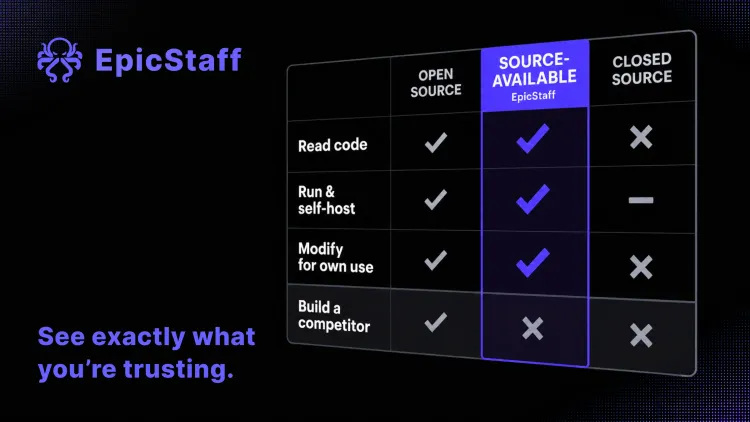
EpicStaff sits in the middle box. Here is the same idea as a table.
| Read the code? | Run & self-host it? | Modify it for your own use? | Use it to build a competing product? | |
|---|---|---|---|---|
| Open source (OSI) | Yes | Yes | Yes | Yes |
| Source-available (EpicStaff, PolyForm Perimeter 1.0.0) | Yes | Yes | Yes | No |
| Closed / proprietary | No | Usually no | No | No |
Look at the first three columns. For everything a buyer of a self-hosted platform actually does — inspect it, deploy it inside your own walls, adapt it to your environment — source-available and open source are the same. The only column where they differ is the last one: selling a rival product. That column matters to your legal team's read of the licence. It does not touch how you use the software.
The restriction is aimed at competitors, not at you
Read that last column again, because this is the point.
The main restriction in PolyForm Perimeter is on competing use. You may not use EpicStaff to provide a product or service that competes with EpicStaff. The licence has a couple of other standard terms too, which you can read in full before you talk to us. What it does not do is restrict which industry you are in. It does not restrict deploying it in a classified environment. It does not restrict modifying it to fit your infrastructure. It does not restrict how many agents you run or what you build with them internally.
If you are a government body, a defence supplier, a bank, or a hospital, you are not our competitor. The one restriction in the licence was never pointed at you. So framing source-available as "open source with a catch" gets it backwards. For you, there is no catch. You get to read it, run it, and change it — which is exactly the list you cared about.
The question a regulated buyer is really asking
Strip away the licence vocabulary and a regulated or sovereignty-conscious buyer is asking one question about any software that will touch sensitive data:
Can I read the code before I trust it?
That question separates the three boxes cleanly. Closed software says no — you trust the description. Open source says yes. Source-available also says yes. In the way that decides whether your security reviewer can actually do their job, source-available and open source give you the same answer.
This is why "is it open source?" is the wrong question to lead with, even though it is the one everybody asks. The question that protects you is narrower and more useful: can I inspect the thing I am about to run inside my network? If a vendor cannot say yes to that, no amount of the right licence label would help you. If they can say yes — as we can — the exact licence family matters to your lawyers and almost nobody else.
You can point a reviewer at our source and let them read the parts that matter to you: what the platform connects out to, how access is handled, what gets written to the audit record. You do not have to accept our word for any of it. You can check. That is the whole value of being source-available, and it is a value you do not lose by our not being OSI open source.
Read the licence — then talk to us
We would rather you not take our word for the distinction either. PolyForm Perimeter 1.0.0 is a short, plain licence. Read it. Read our source while you are there — it is at github.com/EpicStaff/EpicStaff.
Then, when you talk to us, you will already know the one thing that matters: you can see exactly what you would be running, before you trust it with anything.
FAQ
Is EpicStaff open source?
No. EpicStaff is source-available under the PolyForm Perimeter 1.0.0 licence. You can read every line of the code, run it, self-host it, and modify it for your own use. The main restriction is that you may not use it to provide a product or service that competes with EpicStaff. We do not describe EpicStaff as open source, because under the Open Source Initiative's definition it is not.
What is the difference between source-available and open source?
Open source, in the formal sense the Open Source Initiative defines, means the licence places no restriction on what you use the software for — including building a product that competes with the people who wrote it. Source-available means the code is public and you can read, run and modify it, but the licence keeps one narrow restriction, usually on competing use. For inspecting, deploying and adapting the software, the two are the same. They differ only on whether you can sell a rival product.
What does the PolyForm Perimeter licence actually restrict?
Competing use. You may not use EpicStaff to provide a product or service that competes with EpicStaff. The licence contains a few other standard terms, which you can read in full. It does not restrict which industry you operate in, deploying in a classified environment, modifying the software to fit your infrastructure, how many agents you run, or what you build with it internally.
Can our security team review the source code before we deploy it?
Yes. The source is public at github.com/EpicStaff/EpicStaff, so you can point a reviewer at it and have them read the parts that matter to you — what the platform connects out to, how access is handled, and what is written to the audit record. You do not have to rely on our description of what the software does.